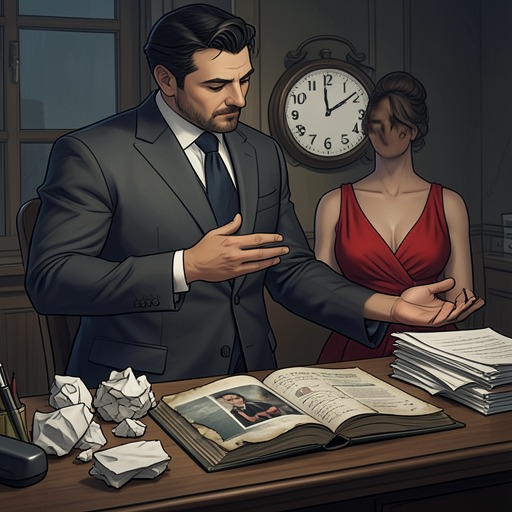
Aaron's ten-year notes
Unchosen By My CEO Husband: A Marriage In Crisis Second Chance RomanceAaron's ten-year notes are a private archive of handwritten messages left by Aaron Colt for Jacinta Colt across their marriage. Folded into a dresser drawer, the notes first function as a tangible, portable version of intimacy: a whole paper marriage that Jacinta can hold in one hand. Their meaning changes when other documents reveal that Aaron has treated her loyalty as a calculated asset. By the end, the old notes are discarded as proof and replaced by a nightly ballot, making the object central to the novel's movement from possession and accounting toward deliberate, reciprocal choice.
Appearance and Preservation
Aaron's notes are simple physical objects, folded and stored in Jacinta's dresser drawer. Their significance comes from repetition and duration rather than from any described ornament or elaborate form. Aaron leaves notes habitually, and ten years of them accumulate into a private record that survives the couple's domestic changes. Jacinta regards the drawer as something she can physically hold when emotional certainty is difficult: the notes offer a compact material form for a marriage otherwise dispersed across time, houses, children, and daily routines.
The notes are also distinguished by their privacy. Aaron later explains that they were the only things he wrote without calculation and the only things he kept private in a house where he concealed other matters. This makes the drawer an archive with two opposing qualities: it preserves genuine feeling, but it also preserves a version of the marriage that can no longer be accepted without examination. The notes are not simply sentimental relics; they are evidence whose meaning depends on what other records bring to light.
From Proof of Love to Evidence
At first, Jacinta calls the accumulated notes proof of love, especially on difficult days when she needs something solid to hold. That interpretation is unsettled when she discovers Aaron's old comparison of Cassandra Vale and herself. In the document, Cassandra is presented as socially convenient and institutionally secure, while Jacinta is described as brilliant, funny, chaotic, and unlikely to leave. The concluding instruction, "J will never leave. C would always be leaving. Choose the one who stays," transforms the notes' emotional context.
The discovery makes Jacinta reread the marriage as a system of valuation. Aaron did not merely choose her in spite of the qualities others found difficult; she understands that he priced those qualities and treated her predictable loyalty as a reliable asset. The notes therefore become implicated in the same language of investment that governs the hotel incident, the program, and the gala. Their physical persistence across ten years and three houses gives them force, but it also shows how a private token can coexist with a public and domestic structure that repeatedly spends the person it claims to value.
This contradiction is not resolved by declaring the notes false. Aaron later insists that every note was real. Their reality is precisely what makes them painful: they testify that genuine feeling existed in him while his choices continued to serve calculation, family pressure, and institutional protection. The notes preserve the evidence of an authentic attachment without proving that Aaron acted faithfully toward it.
Return and Reclassification
When Jacinta prepares to leave, she removes the stack from the dresser drawer and places it on Aaron's pillow, where his notes have always gone. The gesture is a literal return of the object to its maker. It also reverses the direction of the marriage's emotional accounting. What Jacinta once held as proof of love is no longer something she must retain in order to validate the relationship; she sends the proof back, leaving Aaron to confront what it can and cannot establish.
The return follows Jacinta's recognition that Aaron's written rule has governed his conduct. The notes are placed beside the sentence that reduced her staying to a fixed asset, and the old currency of reassurance is refused. The act does not erase the ten years or deny that the messages contained feeling. Instead, it separates feeling from entitlement: Aaron's love, even if real, cannot purchase Jacinta's continued presence.
Replacement by a Daily Choice
After the marriage enters a new phase, the old drawer full of proof is gone. Aaron begins leaving one note on Jacinta's pillow every night, but these new notes are not love notes in the former sense. Each asks the same question: "Still?" Jacinta writes the same answer beneath it: "Yes." The exchange is accompanied by a pen deliberately left for her, and Aaron has learned her systems well enough to make the ritual accessible to her rather than imposing his own form of intimacy.
The revised practice changes the notes from an archive of past assurance into a recurring act of consent. The earlier messages accumulated automatically across ten years and could be treated as evidence that Jacinta would remain. The new note asks for a present answer and leaves the answer to her. Its power depends on the fact that the response is not owed. Staying is no longer represented as a virtue Aaron can rely on or an asset he can spend; it becomes a choice made again by the person whose choice matters.
Narrative and Thematic Significance
Aaron's ten-year notes give the novel a material structure for memory. They allow Jacinta to move from an affectionate interpretation of the past to an evidentiary one, while preserving the possibility that both readings contain truth. The notes are private memory, marital record, and contested proof at once. Their transfer from Jacinta's drawer to Aaron's pillow marks a shift in control over the archive, and their replacement by the "Still?" ritual marks a shift from stored history to present negotiation.
The object also exposes the danger of confusing persistence with commitment. Ten years of messages, preserved through multiple homes and family crises, can look like an unanswerable record of devotion. Yet the novel places that record beside contracts, folders, photographs, and the sentence about choosing the one who stays, showing that documents do not interpret themselves. The notes become meaningful through the systems around them and through the choices made in response to them.
Their final transformation completes the distinction between being kept and being chosen. The old notes represented a marriage that could be held, filed, and used as proof. The nightly question creates a marriage that must be answered. In that movement, Aaron's ten-year notes cease to certify possession of the relationship and become the abandoned archive against which a more honest, daily form of mutual choosing is defined.